Debias Your Intuition: Name It, Then Put It On Trial
Debias Your Intuition: Name It, Then Put It On Trial
Most business decisions begin with a feeling. A hiring committee meets a candidate and thinks, “This person could be a strong fit.” A product team sees a redesign and feels, “This is the right direction.” A strategy team looks at a new market and senses, “This is where we should go next.”
We call this intuition. And we value it. Popular books such as Blink: The Power of Thinking Without Thinking have made this idea compelling. Some judgments seem to happen before conscious reasoning begins. We recognize patterns. We notice subtle cues. We arrive at conclusions quickly. That can be powerful.
But there is a problem. The same business knowledge that encourages professionals to trust their gut also tells them to reduce their biases, as in Pamela Fuller, Mark Murphy, and Anne Chow’s The Leader’s Guide to Unconscious Bias.
Avoid the sunk cost fallacy. That is the tendency to continue investing in something because we have already invested so much, even when the future case is weak. Avoid overconfidence. That is the tendency to believe our judgment is more accurate than it really is. Avoid confirmation bias. That is the tendency to seek evidence that supports what we already believe.
So which is it? Should you trust your instincts? Or should you be cautious about them? The answer is not either-or. The tension becomes clearer once we take an informed cognitive perspective.
Intuition and bias are closely related. Both can emerge from fast, automatic, associative thinking. What Daniel Kahneman called System 1 thinking. System 1 is quick. It is effortless. It recognizes patterns. It fills in gaps. It produces impressions before we have consciously analyzed the situation.
This is useful. An experienced manager may sense that a strategy is unrealistic after five minutes in a meeting. A recruiter may notice that a candidate gives polished but shallow answers. A product professional may feel that a design is elegant but commercially unclear.
These impressions contain real expertise. But System 1 also has a limitation. It does not fully explain itself. It gives us conclusions before it gives us reasons. The reasons come later.
That is where the trap begins. You have an intuition. Then you start explaining it. You talk it through. You build slides. You collect examples. You ask an AI to build the case. The argument becomes richer. The story becomes smoother. The confidence grows. At the end, it feels like careful deliberation. But often it is not. It is an intuition dressed up as analysis.
This is dangerous because deliberate reasoning can become a servant of the gut feeling. Instead of testing the intuition, we protect it. Instead of searching for alternatives, we search for support. That is not deliberation. That is rationalization.
How can we then use our intuition effectively? Treat intuition as a hypothesis. Not as a conclusion. That requires a simple discipline.
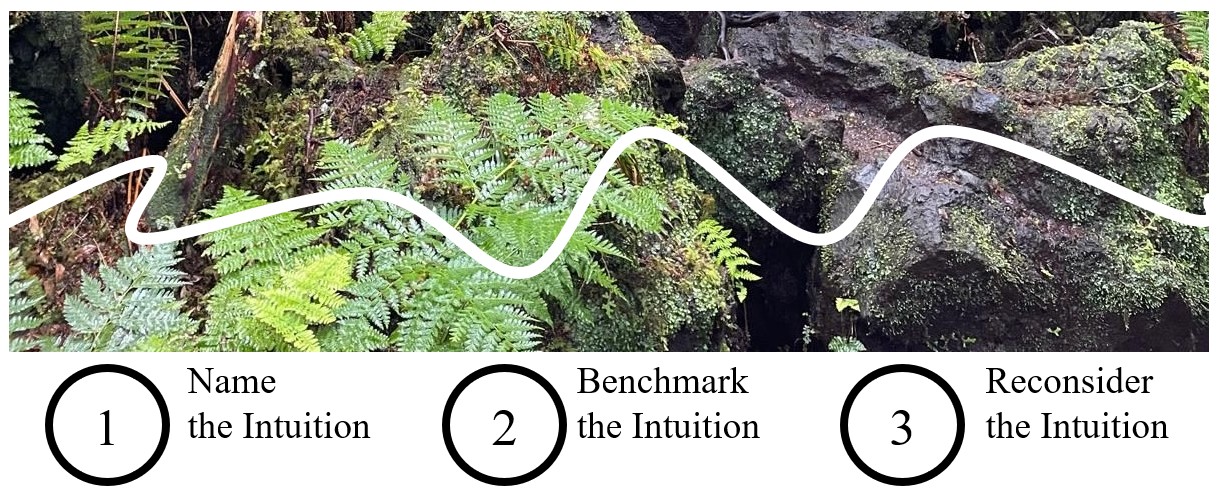
Name the intuition. Benchmark it against the best alternative. Ask what evidence could revise it.
Start by naming the intuition
Put it on the table as an intuition. “My intuition favors this candidate.” “My intuition favors this redesign.” “My intuition favors this market.” It separates the feeling from the conclusion. An unnamed intuition can quietly guide the whole decision. A named intuition can be inspected. This protects the decision process from turning a first impression into a polished argument too early
Benchmark against the strongest rivals
If your intuition favors one candidate, ask how the second-best candidate would perform instead. If your team feels drawn to one redesign, compare it with the strongest alternative concept. Which one better solves the customer’s problem? If one market feels like the obvious next move, compare it with a less intuitive market. Which one offers better conditions for advantage? The point is not to dismiss the intuition. The point is to give it a fair comparison
Ask what evidence could revise the intuition
This is the most demanding step. It requires creating room for doubt. What would make us reconsider? What customer feedback would make another design more convincing? What interview evidence would make another candidate look stronger? What market data would make another opportunity more attractive? Without this question, analysis can become a way to support the first impression. With this question, intuition becomes something we can learn from and test
Consider an expert chess player. They glance at the board. A promising move appears immediately. That first move may be valuable. It reflects years of pattern recognition. But the grandmaster does not stop there. They examine the consequences. They ask what the opponent could do next. They compare the move with other plausible moves. They check whether the first move still holds up. That is a useful model for debiasing intuitions.
Use the intuition. But slow down before treating it as the answer. Make it visible. Compare it with a strong alternative. Ask what evidence could change your mind.
This is how intuition becomes most useful. Not by trusting it blindly. Not by suppressing it. But by working with it carefully.
Name the intuition. Benchmark it against the best alternative. Ask what evidence could revise it.
Then decide.